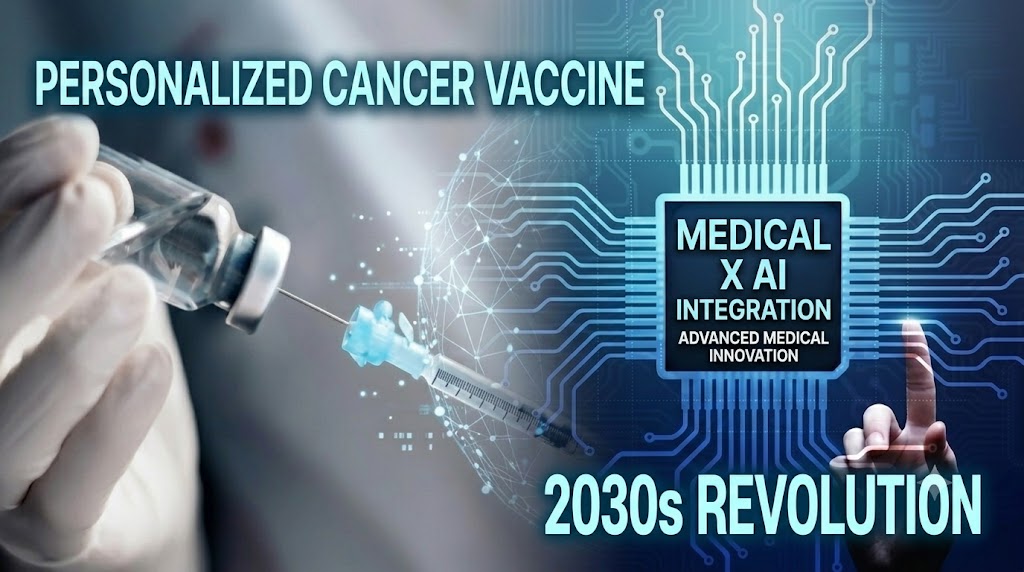
“A Personalized Medical Revolution Through Global Clinical Data: The Realistic Timeline of Conquering Cancer Proven by AI and mRNA”
📌 Table of Contents
- Introduction: Cancer Treatment Vaccine, a New Mechanism for Training the Immune System
- Scientific Definition and Genetic Analysis of Personalized Cancer Treatment Vaccines
- The 3 Core Working Principles of Cancer Treatment Vaccines Reported in Academia
- Global Clinical Trial Status and FDA Approval Prediction (Fact Check as of 2026)
- Conclusion: The Direction of Future Medicine Proven by Verified Data
1. Introduction: Cancer Treatment Vaccine, a New Mechanism for Training the Immune System
Traditional cancer therapies, such as surgery, chemotherapy, and radiation therapy, have faced limitations due to severe side effects caused by the destruction of normal cells while directly attacking cancer cells. Although subsequent developments like targeted therapies and immunotherapies have improved treatment efficiency, a technical gap still remains in completely blocking the continuous genetic mutation and recurrence of cancer cells.
The alternative that academia is verifying to bridge this gap is the [Cancer Treatment Vaccine]. Unlike conventional vaccines that prevent viral infections, a cancer treatment vaccine is a “therapeutic drug” that post-hoc educates the immune system to attack cancer cells that have already developed inside the patient’s body. Recently, the biomedical community has been enhancing the precision of medical treatment by researching personalized therapies that decode and administer a patient’s unique cancer genomic information.
2. Scientific Definition and Genetic Analysis of Personalized Cancer Treatment Vaccines
A personalized [Cancer Treatment Vaccine] is manufactured by analyzing specific genetic mutations present in an individual patient’s cancer tissue. Even among patients diagnosed with clinically identical types of cancer (e.g., lung cancer, pancreatic cancer, etc.), the mutation patterns of cancer cells and the types of neoantigens vary completely from person to person.
For this reason, personalized vaccines undergo a thorough custom manufacturing process, unlike off-the-shelf medicines. First, ultra-high-precision sequencing (gene decoding) technology is used to compare the genetic sequence of the patient’s normal cells with that of the cancer tissue. Through this process, genetic data of mutant proteins expressed exclusively in cancer cells is identified, and this antigen information is turned into a vaccine in the form of a genetic blueprint. Consequently, a foundation is established for the patient’s immune cells (T-cells) to identify and precisely target cancer cells without damaging normal tissue.
3. The 3 Core Working Principles of Cancer Treatment Vaccines Reported in Academia
The core technological elements of the [Cancer Treatment Vaccine] whose efficacy and mechanism have been proven through global biomedical academia and clinical trials are summarized into the following three points:
① Antigen Design Based on the mRNA Platform
The mRNA (messenger RNA) technology, which proved its safety and rapid productivity through the development of COVID-19 vaccines, is centrally applied to cancer vaccines. When mRNA containing genetic information about a cancer cell’s unique antigen is injected into the body, cancer antigen proteins are temporarily synthesized via ribosomes. The immune system, recognizing this through cells like dendritic cells, activates T-cells to induce them to attack the cancer cells in the body.
② Neoantigen Prediction via AI Algorithms
Selecting the most effective neoantigen that can powerfully stimulate immune cells among thousands of genetic mutations in a cancer cell requires advanced computational capabilities. Currently, academia is introducing deep learning-based AI algorithms to accurately predict the “optimal neoantigen” that has the highest binding affinity with T-cells from the patient’s genetic data. This technology has dramatically shortened the period required for vaccine design.
③ Synergy with Co-administration of Immune Checkpoint Inhibitors
Cancer cells secrete specific signaling substances (such as PD-L1) to evade attacks from immune cells. While a [Cancer Treatment Vaccine] provides T-cells with clear target information about cancer cells, immune checkpoint inhibitors (such as Keytruda) play the role of releasing the immune evasion brake used by cancer cells. In clinical settings, it has been reported that anti-cancer effects are maximized when these two mechanisms are combined.
4. Global Clinical Trial Status and FDA Approval Prediction
Currently, the [Cancer Treatment Vaccine] closest to the commercialization stage in the global market is the mRNA-based personalized vaccine (mRNA-4157 / V940) for high-risk melanoma patients, jointly developed by Moderna and Merck (MSD). According to the 5-year follow-up data from the Phase 2b clinical trial reported to academia, the vaccine co-administration group demonstrated a significant clinical achievement, showing a 49% reduction in the risk of cancer recurrence or death compared to the group treated solely with an immune checkpoint inhibitor.
However, the commercialization timeline strictly follows regulatory procedures. The accelerated approval requested by Moderna to the U.S. Food and Drug Administration (FDA) based on early clinical data was rejected, and the FDA demands large-scale Phase 3 clinical trial results for definitive validation of efficacy.
The large-scale global Phase 3 clinical trial (INTerpath-001) has completed patient recruitment and is currently undergoing follow-up observations, with the official primary completion date set for October 2029. Therefore, objectively calculating the successful data derivation of Phase 3 and the duration required for the Biologics License Application (BLA) review, academia and the bio-industry project that the initial official approval and full-scale commercialization of personalized cancer vaccines will take place in the early 2030s (around 2030 to 2032).
Furthermore, clinical trials for pancreatic and colorectal cancers conducted by companies like BioNTech are also progressing sequentially. However, due to the nature of solid tumors, separate Phase 3 trials and approval processes are mandatory for each cancer type. Real-time information on reliable clinical trials can be directly tracked and verified through public academic materials on the official clinical trial registration site of the U.S. National Institutes of Health (ClinicalTrials.gov) or the National Cancer Information Center official portal.
5. Conclusion: The Direction of Future Medicine Proven by Verified Data
The research achievements of personalized [Cancer Treatment Vaccines] factually prove that cancer therapy is evolving beyond the indiscriminate targeting of cells into an era that precisely mobilizes the immune system based on the patient’s genetic information.
Realistic challenges for the scientific community certainly exist, such as the complex customized production process required to design a new vaccine for each individual patient and the high initial manufacturing costs. However, as it has already entered the large-scale Phase 3 clinical trial track and the objective data verification phase, the paradigm of cancer treatment will be completely transformed in the early 2030s when technological completeness and safety are fully secured. Only technologies that pass the strict verification of academia will safely rescue humanity from the fear of cancer.
Hashtags: #CancerTreatmentVaccine #PersonalizedVaccine #mRNACancerVaccine #Phase3ClinicalTrial #Issue-Pick365 #FutureMedicine #BioFactCheck #FDAApprovalOutlook